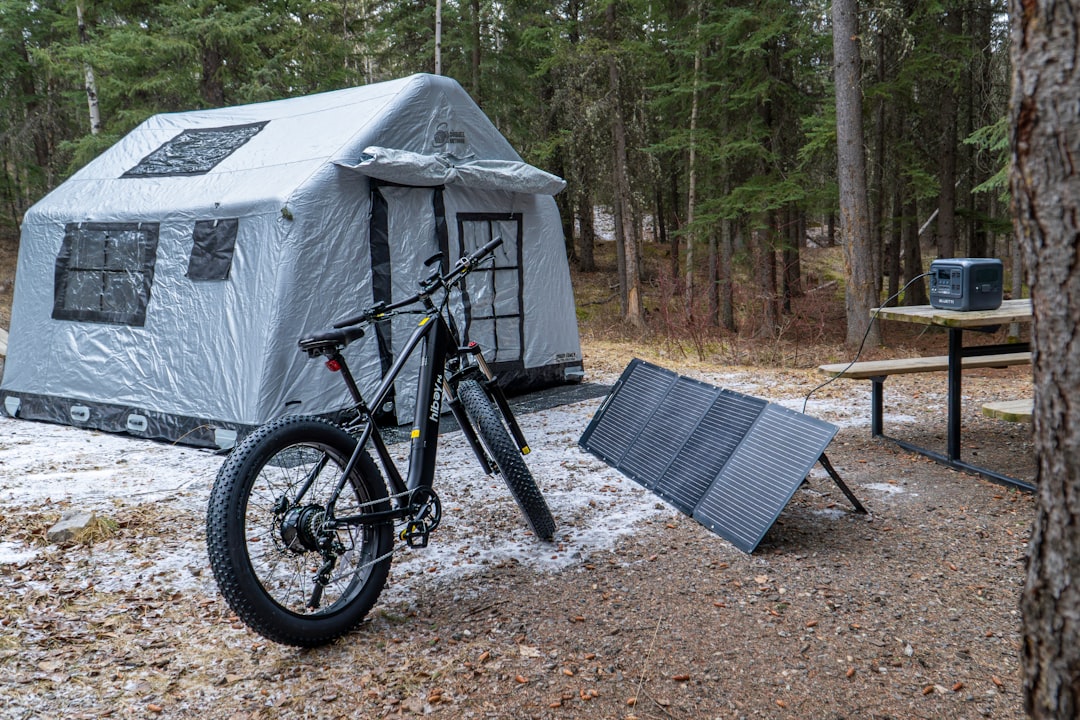
The idea of riding an eBike powered entirely by the sun is appealing. In practice, solar charging for eBikes is a spectrum — from “extends your range by 10% on sunny days” to “fully self-sufficient multi-day touring” — and the practical implementation depends on how much weight you are willing to carry, how much money you want to spend, and how much sun you expect to encounter. This guide covers the three solar charging strategies that actually work for eBike touring, and the one popular approach that does not.

Why Solar eBike Charging Is Not Straightforward
An eBike battery is a 36V or 48V lithium-ion pack storing 300-1,000 Wh of energy. A typical eBike charger draws 300-600 W from the wall outlet. Solar panels produce wildly variable output depending on angle, cloud cover, temperature, and the time of day. The fundamental mismatch is that eBike charging wants concentrated, steady power, while solar delivers diffuse, intermittent power.
This is not to say solar eBike charging does not work — it does, but you need to manage expectations. A well-designed solar setup can add 15-40 km of range per day on a touring trip. It cannot (yet) fully recharge a depleted 625 Wh battery from a portable panel in a single day.
Strategy 1: Spare Battery + Solar (Recommended)
The most reliable solar touring strategy is to carry a second battery and charge it at camp using a foldable solar panel. This separates riding from charging: you ride with one battery while the other charges in the sun. By morning, the overnight battery has 40-70% charge depending on sun exposure. Swap and repeat.
The recommended setup:
- Solar panel: 100-200 W foldable panel (EUR 150-300, 2-4 kg). Look for monocrystalline cells with a built-in MPPT charge controller. Sunpower cells are more efficient but cost 2-3x more.
- Spare battery: Same voltage and connector as your main battery. A 500 Wh spare adds significant weight (3-4 kg) but doubles your effective daily range.
- Charge time: A 200 W panel produces 80-120 Wh per hour in good sun. A 500 Wh battery needs 6-8 hours of full sun for a complete charge. In practice (clouds, angle changes, coffee breaks), plan on 2 days of sun for a full spare-battery recharge.
Strategy 2: Passthrough Charging (While Riding)
Some eBike motors support passthrough charging — drawing power from an external source while the motor is running. This is the closest thing to “solar-powered riding.” The setup requires a solar panel with an output voltage matching the battery voltage (36V or 48V), connected through a DC-DC converter that regulates the voltage to the battery’s acceptable charge range.
The practical limitation is panel size. A 100 W panel mounted on a rear rack produces approximately 30-50 Wh per hour while riding (the panel is rarely perpendicular to the sun). At an eBike consumption rate of 5 Wh/km, that extends your range by 6-10 km per hour of full sun. It is not infinite range, but it is enough to make a difference on a multi-day tour.
Strategy 3: Solar Generator (Heavy but Flexible)
A portable power station (Jackery, EcoFlow, Bluetti) with solar panel input provides the most flexible charging solution. A 700 Wh power station charged by a 200 W solar panel can fully charge a 500 Wh eBike battery in 3-4 hours of good sun. The downside is weight: a 700 Wh power station weighs 7-9 kg, plus the panel (2-3 kg), plus cables. This setup is only practical for car-camping or base-camp touring where you transport gear by vehicle.
What Does NOT Work
Cheap “solar eBike” kits sold on Amazon and eBay claiming to charge your battery while riding from a small panel mounted on the frame. These typically produce 5-15 W of actual power (enough to charge a phone, not an eBike). The marketing images show large panels that are not included in the kit. If a deal seems too good to be true, it is.
Best Solar Panels for eBike Touring (2026)
| Panel | Power | Weight | Price (EUR) | Best For |
|---|---|---|---|---|
| Jackery SolarSaga 100W | 100 W | 4.7 kg | EUR 250-300 | Weekend touring |
| EcoFlow 160W | 160 W | 5.2 kg | EUR 300-350 | Week touring, good value |
| Bluetti PV200 | 200 W | 6.8 kg | EUR 350-400 | Multi-day self-sufficient |
| Sunpower 110W flexible | 110 W | 1.8 kg | EUR 400-500 | Weight-critical touring |
FAQ: Solar eBike Charging
Can a solar panel fully charge an eBike battery in one day?
Only with a large panel and ideal conditions. A 200 W panel in full equatorial sun produces approximately 1,000-1,200 Wh per day (6 hours of effective charging). That is enough for a 500 Wh battery but not for 750+ Wh packs. In Europe (higher latitude, more clouds), expect 30-50% less daily production.
Will solar charging damage my eBike battery?
No, if the solar charge controller outputs the correct voltage for your battery. A proper MPPT (Maximum Power Point Tracking) controller regulates voltage and current to safe levels. Directly connecting a solar panel to a battery without a charge controller can overcharge and damage the cells.
Is solar worth it for eBike commuting?
No. For daily commuting where you charge from a wall outlet every night, solar adds cost and complexity without meaningful benefit. Solar charging is only worth considering for multi-day touring where wall outlets are unavailable.
For more long-range eBike strategies, see our complete 100km+ eBike guide.
