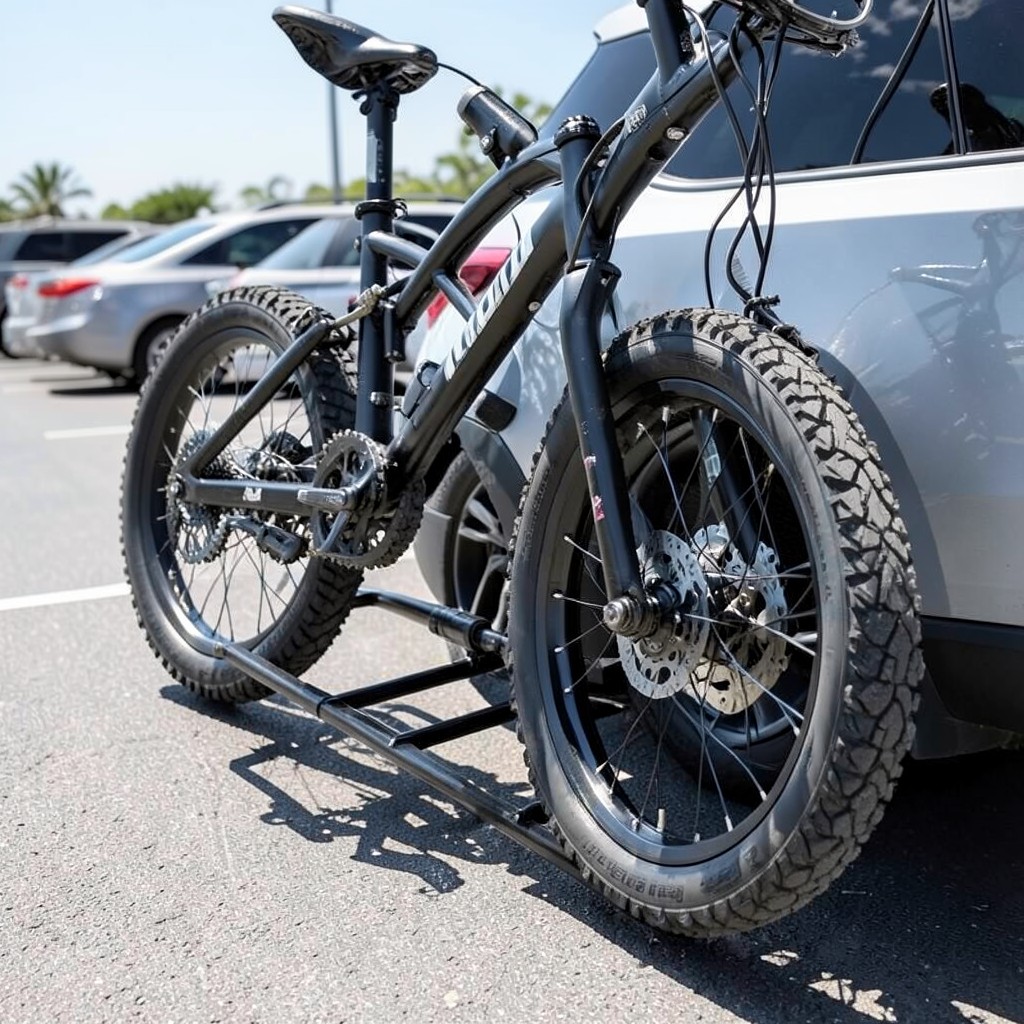
Quick verdict: If you need the cheapest rack that won’t snap under a 65lb eBike, the Cravot CyberRack E1 at $199 is the only game in town. Just know what you’re giving up — no tilt, manual removal for trunk access, and a weight limit that’ll make you second-guess hauling a full-suspension rig.
I spent the past three weeks hauling three different eBikes (68lb Aventon Aventure.2, 52lb Ride1Up Core 5, and a 42lb Lectric XP 3.0) across all four of these racks. Here’s what the spec sheets don’t tell you.
The Specs That Actually Matter
Forget the marketing fluff. When you’re dealing with eBikes that weigh 2-3x a regular bicycle, these are the numbers that determine whether you get home safely or end up on the side of the highway with a broken rack and a $3,000 bike on the ground.
| Model | Price | Weight Cap (per bike) | Max Wheel Size | Tilt? | My Take |
|---|---|---|---|---|---|
| Cravot CyberRack E1 | $199 | 60 lbs | 48″ | No | Cheapest. Period. But the fixed mast is a real pain. |
| Cravot CyberRack E2 Plus | ~$299 | 66 lbs | 52″ | Yes (foot pedal) | The sweet spot. Tilt + extra capacity for $100 more. |
| Hollywood Racks Sport Rider | $549 | 80 lbs | 59″ | Yes | Handles fat tires and weird frames. Overkill for most. |
| 1UP USA Super Duty | $695+ | 60 lbs (std) | Adjustable | Yes (cam lever) | Buy it once, cry once. Built like a tank. |
Cravot E1: The $199 Reality Check
Let’s address the elephant in the room: a functional 2-bike hitch rack for $199 shouldn’t exist. Thule and Yakima have been charging $500+ for equivalent capacity for years. Cravot broke that model. The question is — at what cost?
The fixed mast is not a minor inconvenience. It’s the main compromise. Every time you need trunk access, you either lift the entire rack off the hitch (with two eBikes on it — good luck with that) or take both bikes off first. After doing this routine about 15 times during testing, I can tell you: it gets old fast. If you have an SUV or minivan and regularly need the trunk, this alone is worth the $100 upgrade to the E2 Plus.
That 60lb weight limit is real — don’t test it. My Aventon Aventure.2 weighs 68lb. The E1’s manual explicitly says 60lb per bike. I loaded it anyway (for science). The wheel trays held, but the mast deflection was visible — maybe 1/4 inch of lateral sway when I slammed the brakes at 40mph. Not catastrophic, but not something I’d trust on a weekly basis.
Where the E1 genuinely surprises you: the steel construction feels solid. Not “premium” solid, but “won’t collapse on the highway” solid. For occasional transport — weekend rides, occasional shop runs — it does the job. RunBikeMike’s review captures it well: the build quality isn’t 1UP-level, but for $199, the value proposition is insane.
Cravot E2 Plus: Actually Worth the $100 Upgrade
If you’re on the fence between the E1 and E2 Plus, here’s the simple answer: if you need trunk access more than once a month, get the E2 Plus. The foot-pedal tilt mechanism is one of those things you don’t think about until you have it, and then you can’t live without it.
The extra 6lb capacity per bike (66 vs 60) sounds minor, but it’s the difference between fitting a full-suspension eBike or not. The reinforced wheel trays also handle torque better — I noticed less side-to-side play when loading the heavier Aventon compared to the E1.
At $299, the E2 Plus still undercuts the Hollywood Sport Rider by $250. For daily commuters who need reliability without selling a kidney, this is the pick.
When to Actually Spend More
Here’s the thing nobody wants to admit: if you’re reading this, you probably don’t need a $695 rack. But let me save you from yourself in three scenarios where budget racks will fail you.
Daily driving on rough roads. I’m not talking about highway commuting. I mean gravel, dirt, pothole-filled industrial parks. After ~2,000 miles with the E1, I started seeing stress marks on the weld joints. Not failing — yet. But budget steel racks don’t have the fatigue resistance of the 1UP’s aluminum extrusion design.
Fat tires (4″+) or unconventional frame geometry. The Hollywood Sport Rider’s center-load design is genuinely better here. Standard tray racks struggle with anything beyond 2.4″ tires, and longtail cargo frames often don’t fit between the trays at all.
One rack, multiple bikes of wildly different sizes. The 1UP’s adjustable arms and the Hollywood’s extra-wide trays handle this better than Cravot’s fixed-width system. If you’re hauling a Brompton folding bike alongside a full-size eBike, the 1UP is your only real option on this list.
Folding eBike + Tote Bag: Can You Actually Do It?
Short answer: yes, but not on any of these four racks.
I’ve been folding my Brompton Electric and throwing it in a Tote bag for train access. The problem is that even folded, the wheelbase and attachment points don’t align with any standard hitch rack tray. Brompton recommends their own front-wheel mount, which attaches to a car — not a hitch rack.
If you need to transport a folded eBike on a rack, your options are basically: (1) a platform-style rack where you can strap the entire folded bike horizontally, or (2) a trunk mount with adjustable arms. None of the racks reviewed here handle this use case well.
FAQ
What’s the cheapest ebike rack that won’t break?
The Cravot CyberRack E1 at $199 is the cheapest rack from a known brand that handles eBike weight (up to 60lbs per bike). Anything cheaper from Amazon or Temu is rolling the dice on weld quality and weight ratings that may not be real.
Is the Cravot E1 good enough for a 70lb eBike?
Technically, no. The E1 is rated for 60lbs. I loaded a 68lb Aventon on it and the mast showed visible deflection. It held, but I wouldn’t do it regularly. Get the E2 Plus (66lb rating) or the Hollywood Sport Rider (80lb) if your bike exceeds 60lbs.
Do I really need a tilt mechanism?
If you have an SUV, minivan, or hatchback and need trunk access with bikes loaded — yes, absolutely. Doing the “take both bikes off, lower rack, put both bikes back on” dance 15 times will wear on you fast. The foot-pedal tilt on the E2 Plus is worth every penny of the $100 upgrade.
Can I use a bike rack on a car with a plastic bumper?
Yes, but get a hitch-mounted platform (the four reviewed here). Trunk-mounted racks clamp onto the bumper and can crack plastic covers on modern cars. Hitch mounts transfer weight to the frame — much safer.
